4 Multiple regression
4.1 Introductory examples
Setup: response variable \(y\), predictors \(x_1\), \(x_2\), …, \(x_k\).
4.1.1 Example 1: Fuel Use
Example from Section 2. Information was recorded on fuel usage and average temperature (\(^oF\)) over the course of one week for eight office complexes of similar size. Data are from Bowerman and Schafer (1990).
\(y\) = fuel use,
\(x_1\) = temperature,
\(x_2\) = chill index.
Data:
| Temp | Fuel | Chill |
|---|---|---|
| 28.0 | 12.4 | 18 |
| 28.0 | 11.7 | 14 |
| 32.5 | 12.4 | 24 |
| 39.0 | 10.8 | 22 |
| 45.9 | 9.4 | 8 |
| 57.8 | 9.5 | 16 |
| 58.1 | 8.0 | 1 |
| 62.5 | 7.5 | 0 |
We wish to use \(x_1\) and \(x_2\) to predict \(y\). This should give more accurate predictions than either \(x_1\) or \(x_2\) alone.
A multiple linear regression model is: fuel use \(\approx\) a linear function of temperature and chill index.
More precisely:
\[y = \beta_0 + \beta_1 x_1 + \beta_2 x_2 + \epsilon.\]
As before, \(\epsilon\) is the unobserved error, \(\beta_0, \beta_1, \beta_2\) are the unknown parameters.
When \(\mathbb{E}[\epsilon ] = 0\) we have
\[\mathbb{E}[y] = \beta_0 + \beta_1 x_1 + \beta_2 x_2.\]
In SLR we can check model appropriateness by plotting \(y\) vs \(x\) and observing whether the points fall close to a line. Here we could construct a 3-d plot of \(y\), \(x_1\), \(x_2\) and points should fall close to a plane.
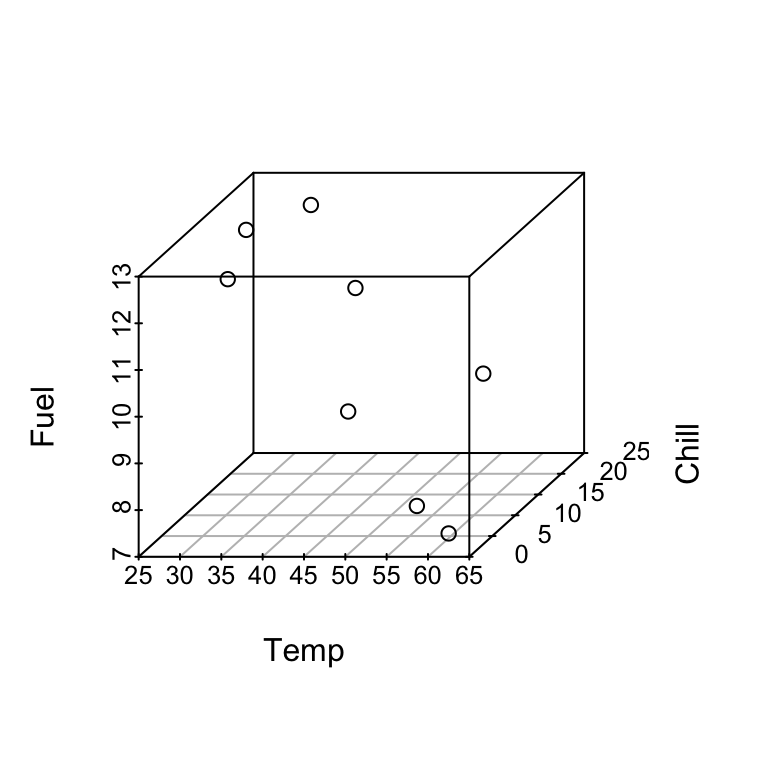
For a given set of values of \(x_1\) and \(x_2\), say \(x_1 = 45.9\) and \(x_2 = 8\), the model says that the mean fuel use is:
\[\mathbb{E}[y] = \beta_0 + \beta_1 \times 45.9 + \beta_2 \times 8.\]
If \(x_1 = x_2 = 0\) then \(\mathbb{E}[y] = \beta_0\), the model intercept.
To interpret \(\beta_1\) suppose \(x_1 = t\) and \(x_2 = c\). Then
\[\mathbb{E}[y]=\beta_0 + \beta_1 \times t + \beta_2 \times c.\]
Now suppose \(x_1\) increases by \(1\) and \(x_2\) stays fixed:
\[\mathbb{E}[y]=\beta_0 + \beta_1 \times (t + 1) + \beta_2 \times c.\]
Substracting these we find that \(\beta_1\) is the increase in \(\mathbb{E}[y]\) associated with 1 unit increase in \(x_1\) for a fixed \(x_2\).
I.e. two weeks having the same chill index but whose temperature differed by \(1^o\) would have a mean fuel use difference of \(\beta_1\).
4.1.2 Example 2: Categorical predictors
Suppose we wish to predict the fuel efficiency of different car types. Data are from Cryer and Miller (1991). We have data on:
\(y\) = gallons per mile (gpm),
\(x_1\) = car weight (w),
\(x_2\) = transmission type (ttype): 1 = automatic or 0 = manual.
We use the model
\[\mathbb{E}[y] = \beta_0 + \beta_1 x_1 + \beta_2 x_2.\]
\(\beta_0\) = the mean gpm for cars of weight \(w = 0\) and ttype = manual. \(\beta_1\) = change in mean gpm when weight increases by 1 for the same ttype. \(\beta_2\) = change in mean gpm when the car of the same weight is changed from manual to automatic.
The model says that:
\[\begin{align*} \mathbb{E}[y] & = \beta_0 + \beta_1 x_1 \quad \mbox{ for manual}\\ & = \beta_0 + \beta_2 + \beta_1 x_1 \quad \mbox{ for automatic.} \end{align*}\]
Therefore we are fitting two lines with different intercepts but the same slope.
The data should look like:
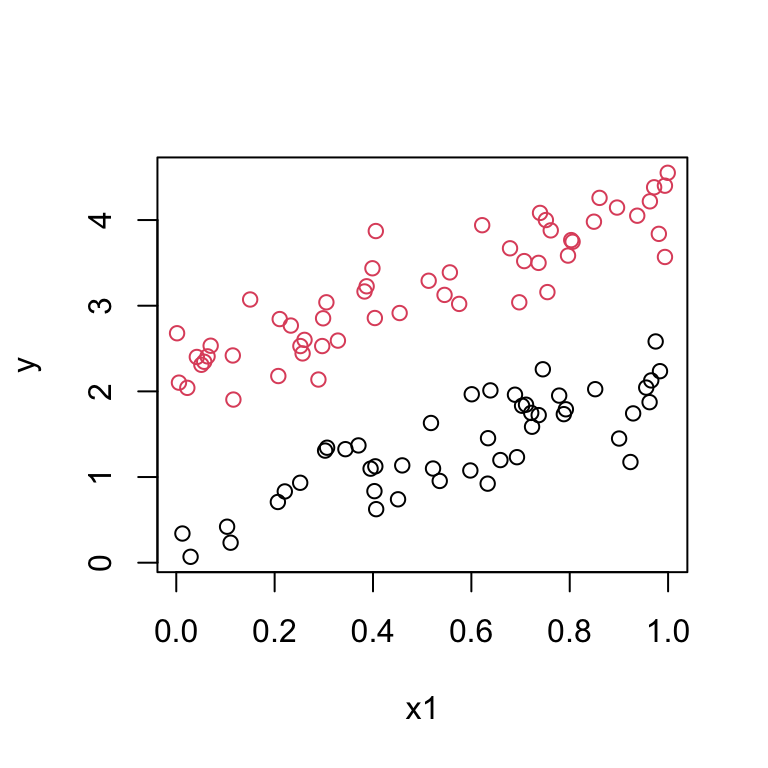
Suppose the data look like this:
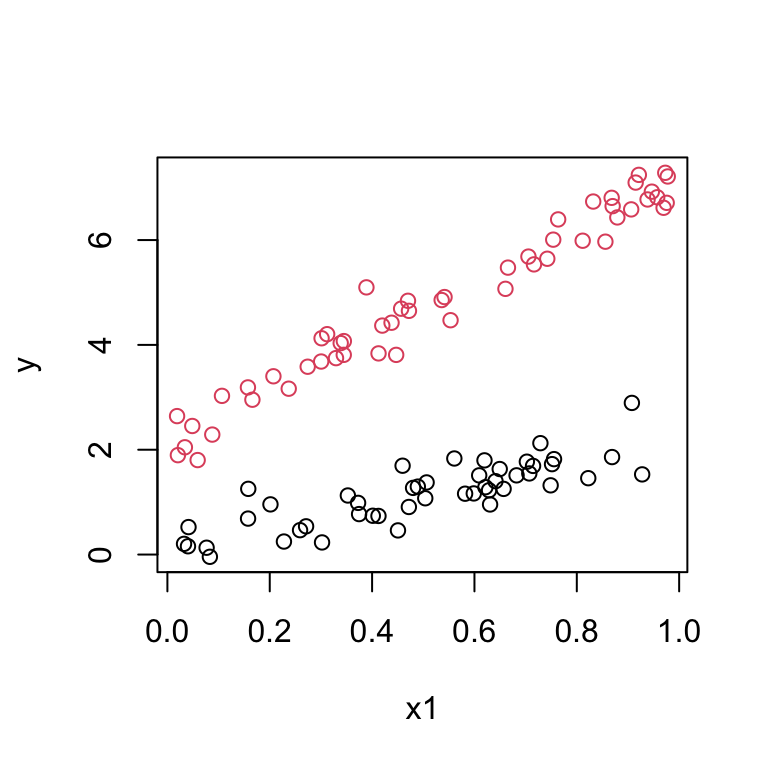
This suggests we should fit two lines with different intercepts and different slopes. We introduce a third predictor:
\[\mathbb{E}[y] = \beta_0 + \beta_1 x_1 + \beta_2 x_2 + \beta_3 x_1x_2,\]
giving:
\[\begin{align*} \mathbb{E}[y] & = \beta_0 + \beta_1 x_1 \quad \mbox{ for manual}\\ & = (\beta_0 + \beta_2) + (\beta_1 + \beta_3) x_1 \quad \mbox{ for automatic.} \end{align*}\]
The term \(x_1x_2\) is called an interaction term.
Here:
\(\beta_2\) = difference in intercept
\(\beta_3\) = difference in slope.
4.1.3 Example 3: Polynomials
We have one predictor \(x\) but the plot of \(y\) vs \(x\) exhibits a quadratic pattern.
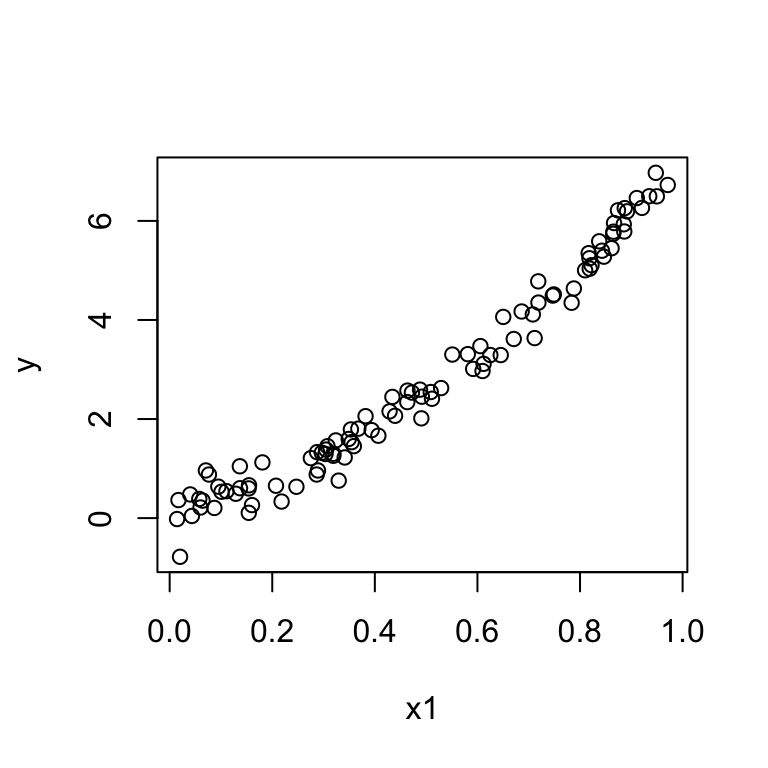 Then we can fit a multiple regression model:
\[\mathbb{E}[y] = \beta_0 + \beta_1 x + \beta_2 x^2.\]
This is also called a quadratic regression model or, more generally, a polynomial regression model.
Higher order polynomial regression models can also be used if needed.
4.1.4 Example 4: Nonlinear relationships
For example,
\[y = \alpha x_1 ^{\beta x_2} \epsilon.\]
Nonlinear models can sometimes be linearized, for example:
\[log(y) = log(\alpha) + \beta x_2 log(x_1) + log(\epsilon).\]
Here: \(x = x_2 log(x_1)\).
NOTE: the term linear refers to the linearity of regression parameters.
A general form for multiple linear regression model (with two explanatory variables):
\[y = \beta_0 f_0(x_1, x_2) + \beta_1 f_1(x_1, x_2) + \beta_2 f_2(x_1, x_2) + \dots\]
where \(f_j(x_1, x_2)\) are known functions of explanatory variables.
The extension to more than two explanatory variables is straightforward.
4.1.5 Diamonds data
diamonds |> ggplot(aes(x = carat, y = log(price), col = color)) + geom_point() +
  facet_wrap(~clarity)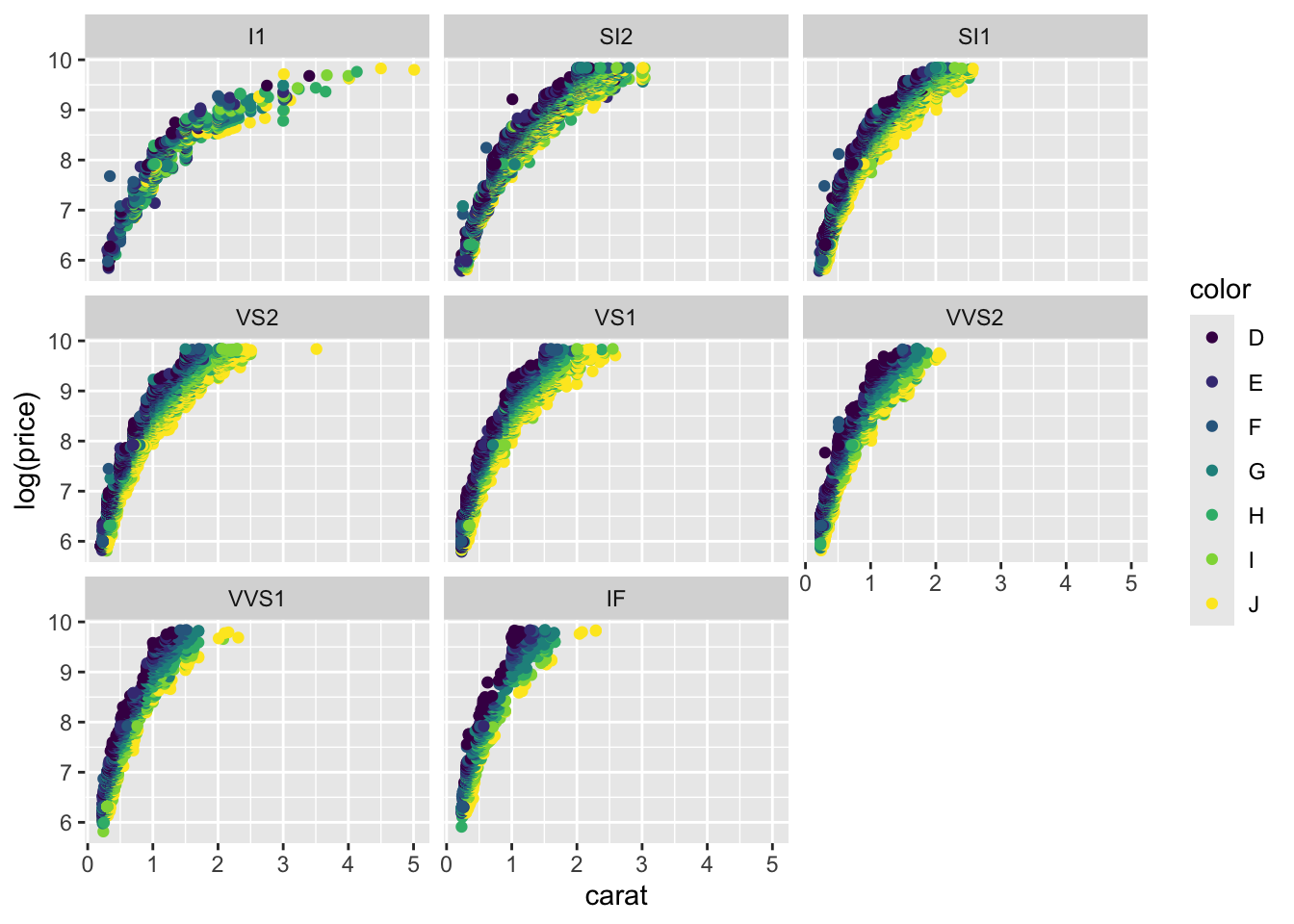
# model.orig <- lm(log(price) ~ poly(carat,2) + color + clarity +cut,  diamonds)
# summary(model.orig)
4.1.6 Cigarette Data continued
Data from 3.7.4. Consider a second predictor (weight):
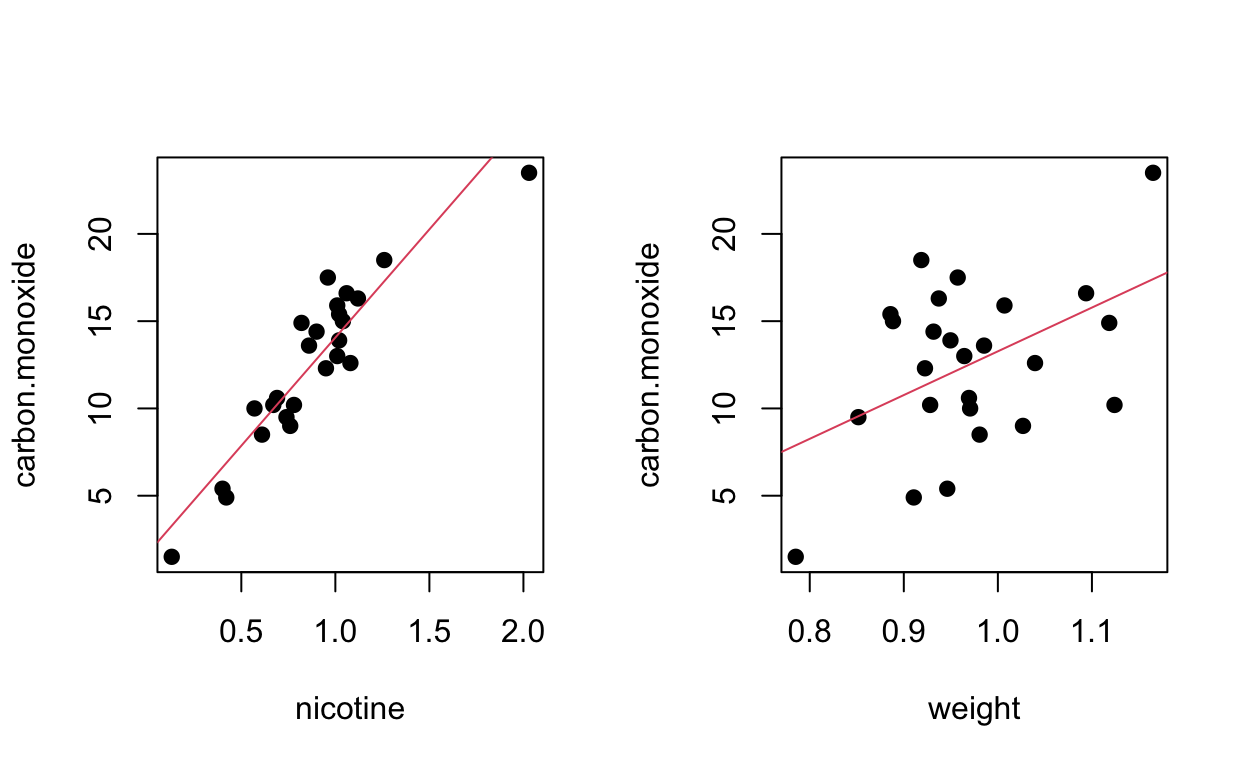
Regression (nicotine only)
summary(fit)##
## Call:
## lm(formula = carbon.monoxide ~ nicotine)
##
## Residuals:
## Min 1Q Median 3Q Max
## -3.3273 -1.2228 0.2304 1.2700 3.9357
##
## Coefficients:
## Estimate Std. Error t value Pr(>|t|)
## (Intercept) 1.6647 0.9936 1.675 0.107
## nicotine 12.3954 1.0542 11.759 3.31e-11 ***
## ---
## Signif. codes: 0 '***' 0.001 '**' 0.01 '*' 0.05 '.' 0.1 ' ' 1
##
## Residual standard error: 1.828 on 23 degrees of freedom
## Multiple R-squared: 0.8574, Adjusted R-squared: 0.8512
## F-statistic: 138.3 on 1 and 23 DF, p-value: 3.312e-11Regression (weight only)
summary(fit2)##
## Call:
## lm(formula = carbon.monoxide ~ weight)
##
## Residuals:
## Min 1Q Median 3Q Max
## -6.524 -2.533 0.622 2.842 7.268
##
## Coefficients:
## Estimate Std. Error t value Pr(>|t|)
## (Intercept) -11.795 9.722 -1.213 0.2373
## weight 25.068 9.980 2.512 0.0195 *
## ---
## Signif. codes: 0 '***' 0.001 '**' 0.01 '*' 0.05 '.' 0.1 ' ' 1
##
## Residual standard error: 4.289 on 23 degrees of freedom
## Multiple R-squared: 0.2153, Adjusted R-squared: 0.1811
## F-statistic: 6.309 on 1 and 23 DF, p-value: 0.01948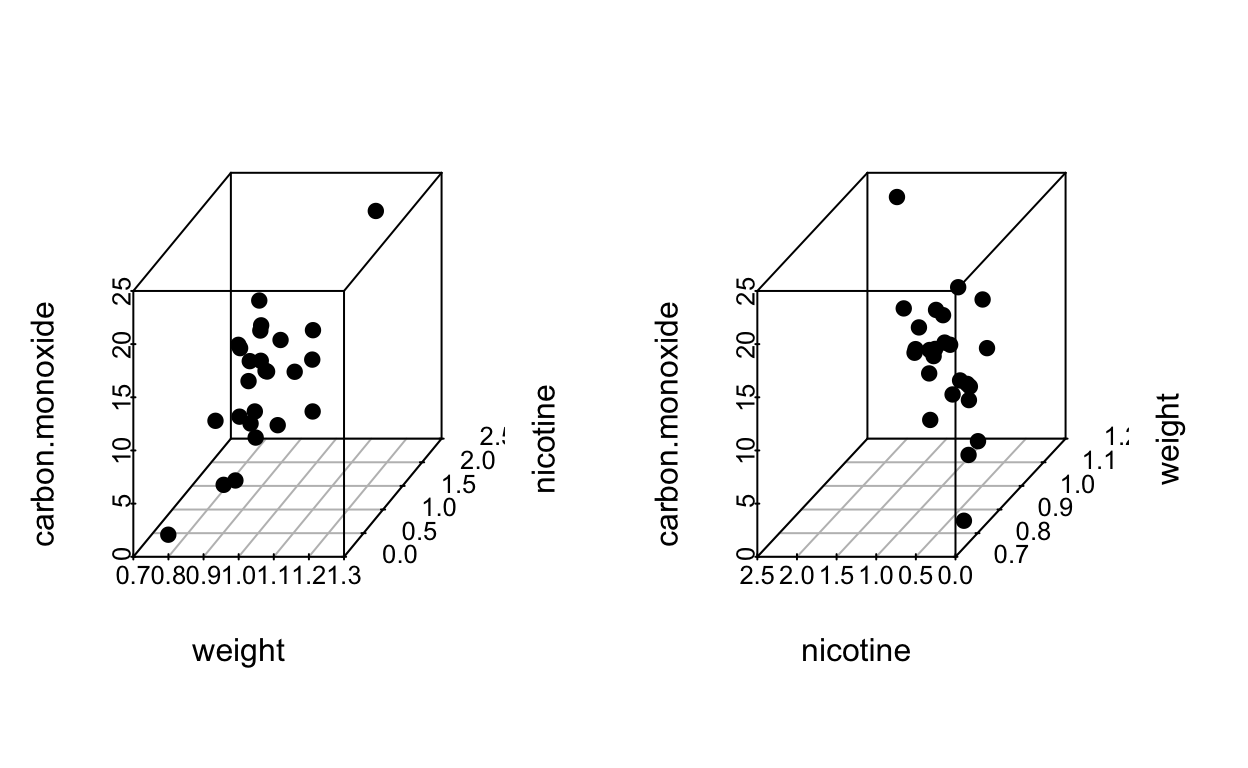
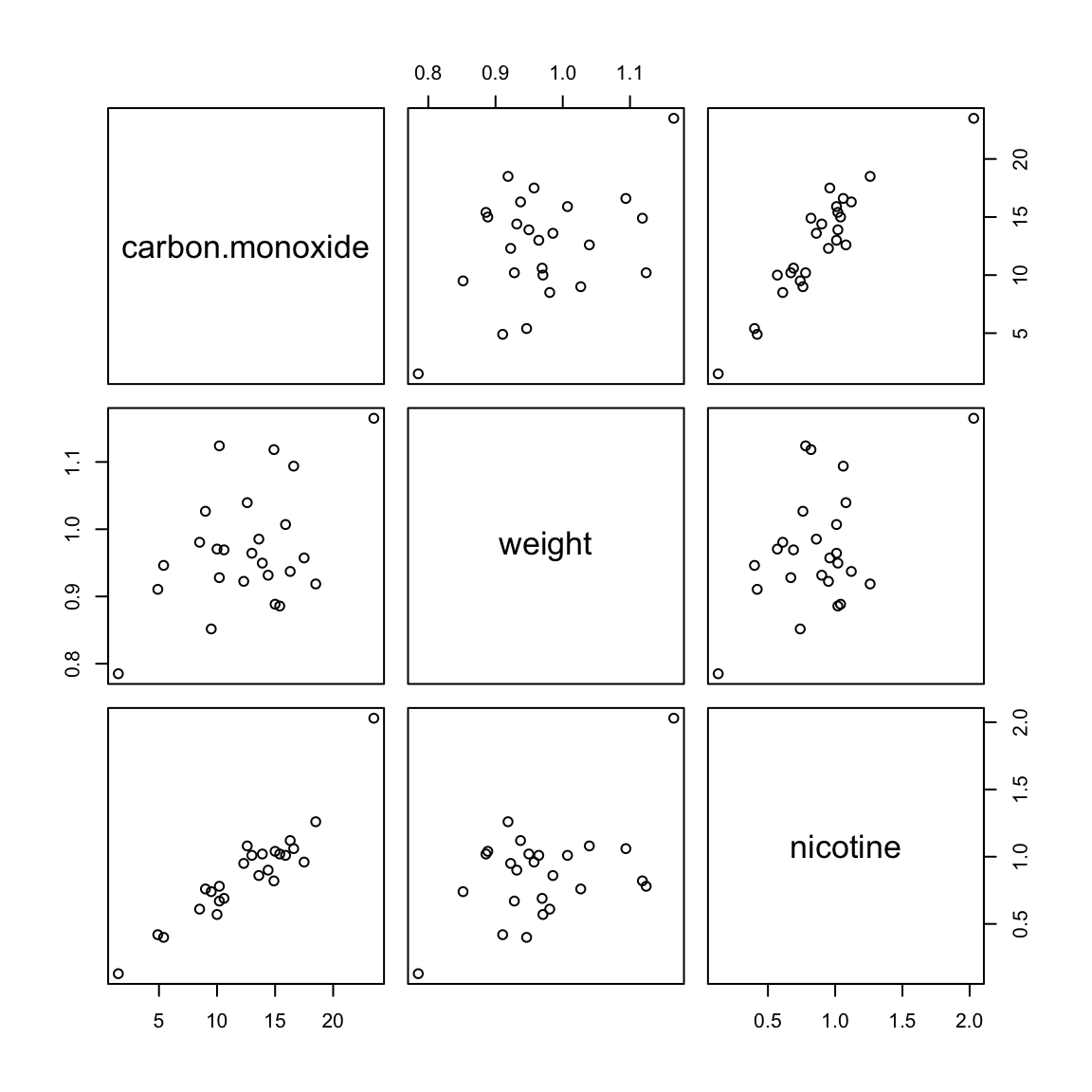
Regression (both predictors)
##
## Call:
## lm(formula = carbon.monoxide ~ weight + nicotine)
##
## Residuals:
##     Min      1Q  Median      3Q     Max
## -3.3304 -1.2249  0.2314  1.2677  3.9371
##
## Coefficients:
##             Estimate Std. Error t value Pr(>|t|)
## (Intercept)  1.61398    4.44663   0.363    0.720
## weight       0.05883    5.02395   0.012    0.991
## nicotine    12.38812    1.24473   9.952 1.32e-09 ***
## ---
## Signif. codes:  0 '***' 0.001 '**' 0.01 '*' 0.05 '.' 0.1 ' ' 1
##
## Residual standard error: 1.87 on 22 degrees of freedom
## Multiple R-squared:  0.8574, Adjusted R-squared:  0.8444
## F-statistic: 66.13 on 2 and 22 DF,  p-value: 4.966e-10
Regression (quadratic)
##
## Call:
## lm(formula = carbon.monoxide ~ nicotine + nicotine.sq)
##
## Residuals:
##     Min      1Q  Median      3Q     Max
## -2.9857 -1.1052  0.1834  0.8654  3.4145
##
## Coefficients:
##             Estimate Std. Error t value Pr(>|t|)
## (Intercept)   -1.784      1.453  -1.227  0.23264
## nicotine      20.111      2.775   7.248 2.92e-07 ***
## nicotine.sq   -3.730      1.267  -2.945  0.00749 **
## ---
## Signif. codes:  0 '***' 0.001 '**' 0.01 '*' 0.05 '.' 0.1 ' ' 1
##
## Residual standard error: 1.583 on 22 degrees of freedom
## Multiple R-squared:  0.8977, Adjusted R-squared:  0.8884
## F-statistic: 96.53 on 2 and 22 DF,  p-value: 1.284e-11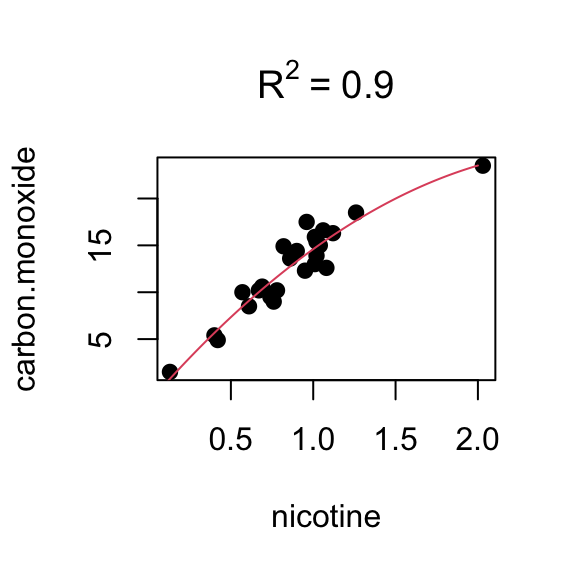
4.2 Least squares estimation for multiple regression
Our model states that:
\[y = \beta_0 + \beta_1x_{1} + \beta_2x_{2} + ... + \beta_kx_k + \epsilon,\]
where \(k<n\).
For each observation we have:
\[y_i = \beta_0 + \beta_1x_{i1} + \beta_2x_{i2} + ... + \beta_kx_{ik} + \epsilon_i.\]
We can write this more compactly using matrix notation.
Let \(\mathbf{Y}\) be the response vector:
\[\mathbf{Y} =\begin{bmatrix} y_{1} \\ y_{2} \\ \vdots\\ y_{n} \end{bmatrix}\]
Let \(\mathbf{X}\) be the \(n \times p\) matrix, where \(p = k+1\):
\[\mathbf{X} = \begin{bmatrix} 1 & x_{11} & x_{12} & x_{13} & \dots & x_{1k} \\ 1 & x_{21} & x_{22} & x_{23} & \dots & x_{2k} \\ \vdots & \vdots & \vdots & \vdots & \ddots & \vdots \\ 1 & x_{n1} & x_{n2} & x_{n3} & \dots & x_{nk} \end{bmatrix}\]
Let \(\boldsymbol{\beta}\) be the \(p\)-dim parameter vector:
\[\boldsymbol{\beta} =\begin{bmatrix} \beta_{0} \\ \beta_{1} \\ \vdots\\ \beta_{k} \end{bmatrix}\]
Let \(\boldsymbol{\epsilon}\) be the \(n\)-dim error vector:
\[\boldsymbol{\epsilon} =\begin{bmatrix} \epsilon_{1} \\ \epsilon_{2} \\ \vdots\\ \epsilon_{n} \end{bmatrix}\]
The model states that:
\[\mathbf{Y}=\mathbf{X}\boldsymbol{\beta} + \boldsymbol{\epsilon}.\]
The vector of fitted values is:
\[\hat{\mathbf{Y}}=\mathbf{X}\hat{\boldsymbol{\beta}}.\]
The corresponding residual values are:
\[\mathbf{e}=\mathbf{Y}-\hat{\mathbf{Y}}.\]
The OLS estimates minimise:
\[S(\boldsymbol{\beta}) = \sum_{i=1}^{n}(y_i-\beta_0-\beta_1x_{i1}- ... - \beta_kx_{ik})^2\]
over \(\boldsymbol{\beta}\).
Therefore the OLS estimates satisfy:
\[\frac{\delta S(\boldsymbol{\beta})}{\delta \beta_j} = 0, \quad \forall j\]
and as before we evaluate at \(\hat{\boldsymbol{\beta}}\)
\[\frac{\delta S(\boldsymbol{\beta})}{\delta \beta_0} = -2 \sum_{i=1}^{n}(y_i-\beta_0-\beta_1x_{i1}- ... - \beta_kx_{ik})\]
\[\frac{\delta S(\boldsymbol{\beta})}{\delta \beta_j} = -2 \sum_{i=1}^{n} x_{ij}(y_i-\beta_0-\beta_1x_{i1}- ... - \beta_kx_{ik}), \quad \forall j = 1,...,k.\]
The OLS estimates of \(\boldsymbol{\beta}\) satisfy:
\[\sum_{i=1}^{n}(y_i-\hat{\beta}_0-\hat{\beta}_1x_{i1}- ... - \hat{\beta}_kx_{ik}) = 0\]
and
\[\sum_{i=1}^{n}(y_i-\hat{\beta}_0-\hat{\beta}_1x_{i1}- ... - \hat{\beta}_kx_{ik})x_{ij} = 0, \quad \forall j = 1,...,k.\]
These normal equations (see (3.1) and (3.2)) can be written as:
\[\sum_{i=1}^{n}e_i = 0\]
and
\[\sum_{i=1}^{n}x_{ij}e_i = 0, \quad \forall j = 1,...,k.\]
We can combine this into one matrix equation:
\[\mathbf{X}^T\mathbf{e}= \mathbf{0}\]
or equivalently:
\[\mathbf{X}^T(\mathbf{Y} - \mathbf{X}\hat{\boldsymbol{\beta}})= \mathbf{0}\]
Therefore the OLS estimator \(\hat{\boldsymbol{\beta}}\) satisfies:
\[\begin{align} \mathbf{X}^T\mathbf{X}\hat{\boldsymbol{\beta}} &= \mathbf{X}^T\mathbf{Y}\\ \hat{\boldsymbol{\beta}} &= (\mathbf{X}^T\mathbf{X})^{-1} \mathbf{X}^T\mathbf{Y}.\tag{4.1} \end{align}\]
Matrix \(\mathbf{X}^T\mathbf{X}\) is non-singular (i.e has an inverse) iff \(rank(\mathbf{X}) =p\), i.e. \(\mathbf{X}\) has full rank and the columns of \(\mathbf{X}\) are linearly independent.
4.3 Prediction from multiple linear regression model
As we have seen already, to predict from a multiple regression model we use:
\[\hat{y}_i = \hat{\beta}_0+ \hat{\beta}_1x_{i1}+ \cdots+\hat{\beta}_kx_{ik}\]
or \[\hat{\mathbf{Y}} = \mathbf{X}\hat{\boldsymbol{\beta}}\]
At a particular set of \(x_0\) values we predict the response \(y_0\) by:
\[\hat{y}_0 = \mathbf{x}_0^T\hat{\boldsymbol{\beta}}\]
where \(\mathbf{x}_0^T = ( 1, x_{01},x_{02},..., x_{0k})\).
We also use \(\hat{y}_0\) to estimate \(\mathbb{E}(y_0)\), the mean of \(y_0\) at a given set of \(x_0\) values.
The \(\mbox{S.E.}\) for the estimate of the mean \(\mathbb{E}(y_0)\) is:
\[\mbox{S.E.}_{\mbox{fit}} (\hat{y}_0)= \hat{\sigma}\sqrt{\mathbf{x}_0^T(\mathbf{X}^T\mathbf{X})^{-1}\mathbf{x}_0}.\]
A \(1-\alpha\) confidence interval for the expected response at \(\mathbf{x}_0\) is given by:
\[\hat{y}_0 \pm t_{n-p}(\alpha/2) \times \mbox{S.E.}_{\mbox{fit}} (\hat{y}_0).\]
The \(\mbox{S.E.}\) for the predicted \(y_0\):
\[\mbox{S.E.}_{\mbox{pred}}(\hat{y}_0) = \hat{\sigma}\sqrt{1+ \mathbf{x}_0^T(\mathbf{X}^T\mathbf{X})^{-1}\mathbf{x}_0}.\]
Note: \[\mbox{S.E.}_{\mbox{pred}}(\hat{y}_0)= \sqrt{\hat{\sigma}^2+\mbox{S.E.}_{\mbox{fit}}(\hat{y}_0)^2}\]
4.4 Regression models in matrix notation: examples
4.4.1 Example 1: SLR
The \(\mathbf{X}\) matrix is:
\[\mathbf{X} = \begin{bmatrix} 1 & x_{1}\\ \vdots & \vdots\\ 1 &x_{n} \end{bmatrix}\]
To estimate the coefficients \(\hat{\boldsymbol{\beta}}\):
\[\begin{align*} \mathbf{X}^T\mathbf{X} &= \begin{bmatrix} n & \sum x_{i}\\ \sum x_{i}& \sum x_{i}^2 \end{bmatrix}\\ (\mathbf{X}^T\mathbf{X})^{-1} & = \frac{1}{n \sum x_{i}^2 - (\sum x_{i})^2}\begin{bmatrix} \sum x_{i}^2& -\sum x_{i}\\ -\sum x_{i} & n \end{bmatrix} \\ & = \frac{1}{n (\sum x_{i}^2 - n\bar{x}^2)}\begin{bmatrix} \sum x_{i}^2 & -n\bar{x} \\ -n\bar{x} & n \end{bmatrix} \\ & = \frac{1}{S_{xx}}\begin{bmatrix} \sum x_{i}^2/n & -\bar{x} \\ -\bar{x} & 1 \end{bmatrix} \\ \mathbf{X}^T\mathbf{Y} &= \begin{bmatrix} \sum y_{i} \\ \sum x_{i}y_{i} \end{bmatrix} = \begin{bmatrix} n\bar{y} \\ \sum x_{i}y_{i} \end{bmatrix}\\ \hat{\boldsymbol{\beta}} & = (\mathbf{X}^T\mathbf{X})^{-1}\mathbf{X}^T\mathbf{Y} \\ & = \frac{1}{S_{xx}}\begin{bmatrix} \bar{y}\sum x_{i}^2 -\bar{x} \sum x_{i}y_i \\ -n \bar{x} \bar{y} + \sum x_{i}y_i \end{bmatrix} \end{align*}\]
With some algebra, this gives:
\[\hat{\beta}_1 = \frac{S_{xy}}{S_{xx}}\] and
\[\hat{\beta}_0= \bar{y} - \hat{\beta}_1\bar{x}\]
as before, and
\[\begin{align*} \mbox{Var}(\hat{\boldsymbol{\beta}})& = (\mathbf{X}^T\mathbf{X})^{-1}\sigma^2\\ & = \frac{\sigma^2}{S_{xx}} \begin{bmatrix} \sum x_{i}^2/n& -\bar{x} \\ -\bar{x}& 1 \end{bmatrix} \end{align*}\]
which gives
\[\mbox{Var}(\hat{\beta}_0) = \sigma^2\left(\frac{1}{n}+ \frac{\bar{x}^2}{S_{xx}}\right),\]
\[\mbox{Var}(\hat{\beta}_1) = \frac{\sigma^2}{S_{xx}},\]
\[\mbox{Cov}(\hat{\beta}_0, \hat{\beta}_1) = -\bar{x}\frac{\sigma^2}{S_{xx}}.\]
4.4.2 Example 2
Example from Stapleton (2009), Problem 3.1.1, pg 81.
A scale has 2 pans. The measurement given by the scale is the difference between the weight in pan 1 and pan 2, plus a random error \(\epsilon\).
Suppose that \(\mathbb{E}[\epsilon] = 0\) and \(\mbox{Var}(\epsilon) = \sigma^2\) and the \(\epsilon_i\) are independent.
Suppose also that two objects have weight \(\beta_1\) and \(\beta_2\) and that 4 measurements are taken:
- Pan 1: object 1, Pan 2: empty
- Pan 1: empty, Pan 2: object 2
- Pan 1: object 1, Pan 2: object 2
- Pan 1: object 1 and 2, Pan 2: empty
Let \(y_1\), \(y_2\), \(y_3\) and \(y_4\) be the four observations. Then:
\[\begin{align*} y_1 & = \beta_1 + \epsilon_1\\ y_2 & =- \beta_2 + \epsilon_2\\ y_3 & = \beta_1 - \beta_2 + \epsilon_3\\ y_4 & = \beta_1 + \beta_2 + \epsilon_4\\ \end{align*}\]
\(\mathbf{X} = \begin{bmatrix} 1 &0 \\ 0 & -1 \\ 1 & -1 \\ 1 & 1 \end{bmatrix}\)
\(\mathbf{Y} = \begin{bmatrix} y_1 \\ y_2 \\ y_3 \\ y_4 \end{bmatrix}\)
\(\boldsymbol{\beta} = \begin{bmatrix} \beta_1 \\ \beta_2 \end{bmatrix}\)
\(\boldsymbol{\epsilon} = \begin{bmatrix} \epsilon_1 \\ \epsilon_2 \\ \epsilon_3 \\ \epsilon_4 \end{bmatrix}\)
The model is:
\[\mathbf{Y} = \begin{bmatrix} 1 &0 \\ 0 & -1 \\ 1 & -1 \\ 1 & 1 \end{bmatrix} \times\begin{bmatrix} \beta_1 \\ \beta_2 \end{bmatrix} + \boldsymbol{\epsilon} = \mathbf{X}\boldsymbol{\beta} + \boldsymbol{\epsilon}\]
The OLS estimates of \(\boldsymbol{\beta}\) are given by:
\[\hat{\boldsymbol{\beta}} = (\mathbf{X}^T\mathbf{X})^{-1} \mathbf{X}^T\mathbf{Y}.\]
\[\begin{align*} \mathbf{X}^T\mathbf{X} & = \begin{bmatrix} 1 & 0 & 1 & 1\\ 0 & -1 & -1 & 1\\ \end{bmatrix} \begin{bmatrix} 1 & 0 \\ 0 & -1 \\ 1 & -1 \\ 1 & 1\\ \end{bmatrix}\\ & = \begin{bmatrix} 3 & 0 \\ 0 & 3 \\ \end{bmatrix}\\ & = 3\begin{bmatrix} 1 & 0 \\ 0 & 1 \\ \end{bmatrix}\\ \mathbf{X}^T\mathbf{Y} &= \begin{bmatrix} y_1 + y_3 + y_4\\ -y_2 - y_3 + y_4\\ \end{bmatrix}\\ \hat{\boldsymbol{\beta}} & = (\mathbf{X}^T\mathbf{X})^{-1} \mathbf{X}^T\mathbf{Y}\\ & = \frac{1}{3}\begin{bmatrix} 1 & 0 \\ 0 & 1 \\ \end{bmatrix} \begin{bmatrix} y_1 + y_3 + y_4\\ -y_2 - y_3 + y_4\\ \end{bmatrix}\\ & = \frac{1}{3}\begin{bmatrix} y_1 + y_3 + y_4\\ -y_2 - y_3 + y_4\\ \end{bmatrix}\\ \mbox{Var}(\hat{\boldsymbol{\beta}}) &= (\mathbf{X}^T\mathbf{X})^{-1} \sigma^2 = \frac{1}{3}\begin{bmatrix} 1 & 0 \\ 0 & 1 \\ \end{bmatrix} \sigma^2.\\ \end{align*}\]
Can we improve the experiment so that the 4 measurements yield estimates of \(\boldsymbol{\beta}\) with smaller variance?
present design: \(\mbox{Var}(\hat{\beta}_i) = \frac{\sigma^2}{3}\)
Let \(\mathbf{X} = \begin{bmatrix} 1 & -1 \\ 1 & -1 \\ 1 & 1 \\ 1 & 1 \end{bmatrix}\),
\(\mbox{Var}(\hat{\beta}_i) = \frac{\sigma^2}{4}\)
- Let \(\mathbf{X} = \begin{bmatrix} 1 & 0 \\ 1 & 0 \\ 0 & 1 \\ 0 & 1 \end{bmatrix}\),
\(\mbox{Var}(\hat{\beta}_i) = \frac{\sigma^2}{2}\).
4.5 The formal multiple regression model and properties
4.5.1 Concepts: random vectors, covariance matrix, multivariate normal distribution (MVN).
Let \(Y_1,...,Y_n\) be r.v.s defined on a common probability space.
Then \(\mathbf{Y}\) is a random vector.
Let \(\mu_i = \mathbb{E}[y_i]\) and \(\boldsymbol{\mu} = \begin{bmatrix} \mu_1 \\ \vdots \\ \mu_n \end{bmatrix}\).
Then \(\boldsymbol{\mu}\) is a mean vector and we write:
\[\mathbb{E}[\mathbf{Y}] = \boldsymbol{\mu}.\]
Let \(\sigma_{ij} = Cov(y_i, y_j)\). Then \(\boldsymbol{\Sigma}\) is the covariance matrix of \(\mathbf{Y}\), where \(\boldsymbol{\Sigma}_{ij} = [\sigma_{ij}].\)
We write:
\[\mbox{Var}(\mathbf{Y}) = \boldsymbol{\Sigma}.\]
Aside:
\(\mbox{Cov}(Y_i,Y_j) = \mathbb{E}[(Y_i-\mathbb{E}[Y_i])(Y_j-\mathbb{E}[Y_j])]\)
\(\mbox{Cov}(Y_i,Y_i) = \mbox{Var}(Y_i)\)
If \(Y_i,Y_j\) are independent then \(\mbox{Cov}(Y_i,Y_j) = 0\).
When \(Y_i,Y_j\) have bivariate normal distribution, if \(\mbox{Cov}(Y_i,Y_j) = 0\), then \(Y_i,Y_j\) are independent.
Fact: Suppose \(\mathbf{Y}\) has mean \(\boldsymbol{\mu}\) and variance \(\boldsymbol{\Sigma}\). Then for a vector of constants \(\mathbf{b}\) and matrix of constants \(\mathbf{C}\):
\[\mathbb{E}[\mathbf{C}\mathbf{Y} + \mathbf{b}] = \mathbf{C}\boldsymbol{\mu} + \mathbf{b}\]
and
\[\mbox{Var}( \mathbf{C}\mathbf{Y} + \mathbf{b} ) = \mathbf{C}\boldsymbol{\Sigma} \mathbf{C}^T.\]
Defn: A random \(n\) - dim vector \(\mathbf{Y}\) is said to have a MVN distribution if \(\mathbf{Y}\) can be written as \[\mathbf{Y} = \mathbf{A}\mathbf{Z} + \boldsymbol{\mu}\] where:
\(Z_1, Z_2, ..., Z_p\) are iid N(0,1),
\(\mathbf{A}\) is an \(n \times p\) matrix of constants and
\(\boldsymbol{\mu}\) is an \(n\) vector of constants.
Notes:
Random vector \(\mathbf{Z}\) is multivariate normal with mean \(\mathbf{0}\) and covariance \(\mathbf{I}_p\) since \(Z_i\)s are independent so their covariances are 0. We write: \[\mathbf{Z} \sim N_p(\mathbf{0}, \mathbf{I}_p).\]
\(\mathbb{E}[\mathbf{Y}] = \mathbb{E}[\mathbf{A}\mathbf{Z} + \boldsymbol{\mu}] = \boldsymbol{\mu}\),
\(\mbox{Var}(\mathbf{Y}) = \mathbf{A}\mathbf{A}^T\),
\(\mathbf{Y} \sim N_n (\boldsymbol{\mu}, \mathbf{A}\mathbf{A}^T)\).
4.5.2 Multiple regression model
\[\mathbf{Y}=\mathbf{X}\boldsymbol{\beta} + \boldsymbol{\epsilon}.\]
\(\mathbf{Y}=\) \(n\) - dimensional response random vector.
\(\boldsymbol{\beta}=\) unknown \(p\) - dimensional parameter vector.
\(\mathbf{X}=\) an \(n \times p\) matrix of constants.
\(\boldsymbol{\epsilon}=\) \(n\) - dimensional error vector.
Assumptions:
Linearity: \(\mathbb{E}[\boldsymbol{\epsilon} ] =\mathbf{0}\), hence \(\mathbb{E}[\mathbf{Y}] = \mathbf{X}\boldsymbol{\beta}\).
Constant variance and 0 covariances \(\mbox{Var}(\boldsymbol{\epsilon}) = \sigma^2 I_n\) and \(\mbox{Var}(\mathbf{Y}) = \sigma^2 I_n\).
MVN distribution: \(\boldsymbol{\epsilon} \sim N_n(\mathbf{0},\sigma^2 I_n )\) and \(\mathbf{Y} \sim N_n(\mathbf{X}\boldsymbol{\beta},\sigma^2 I_n )\)
Notes: When the off diagonal entries of the covariance matrix of a MVN distribution are 0, the \(Y_1, ..., Y_n\) are independent.
Theorem 4.1 Let \(\hat{\boldsymbol{\beta}}\) be the OLS estimator of \(\boldsymbol{\beta}\). When the model assumptions hold:
\[\hat{\boldsymbol{\beta}} \sim N_p(\boldsymbol{\beta}, (\mathbf{X}^T\mathbf{X})^{-1}\sigma^2)\]
Corollary: \(\hat{\beta}_j \sim N(\beta_j, c_{jj}\sigma^2)\), where \(c_{jj}\) is the \(jj\) entry of \((\mathbf{X}^T\mathbf{X})^{-1}\) for \(j = 0, ..., k\).
Theorem 4.2 Let \(\hat{\sigma}^2 = \frac{\mbox{SSE}}{n-p}\). When the model assumptions hold:
\[(n-p)\frac{\hat{\sigma}^2}{\sigma^2} \sim \chi ^2_{(n-p)}\]
and
\[\mathbb{E}[\hat{\sigma}^2] =\sigma^2\]
The distribution of \(\hat{\sigma}^2\) is independent of \(\hat{\boldsymbol{\beta}}\).
Corollary:
\[\frac{\hat{\beta}_j - \beta_j }{\hat{\sigma} \sqrt{c_{jj}}} \sim t_{n-p}\] So we can do tests and obtain CIs for \(\beta_j\)
4.6 The hat matrix
The vector of fitted values:
\[\hat{\mathbf{Y}} = \mathbf{X}\hat{\boldsymbol{\beta}} = \mathbf{X}(\mathbf{X}^T\mathbf{X})^{-1} \mathbf{X}^T \mathbf{Y} = \mathbf{H}\mathbf{Y}.\]
The hat matrix (also known as the projection matrix):
\[\mathbf{H} = \mathbf{X}(\mathbf{X}^T\mathbf{X})^{-1} \mathbf{X}^T\]
has dimension \(n \times n\) is symmetric (\(\mathbf{H}^T = \mathbf{H}\)) and is idempotent (\(\mathbf{H}^2 = \mathbf{H}\mathbf{H} = \mathbf{H}\)).
We have
\[\hat{\mathbf{Y}}= \mathbf{H}\mathbf{Y}\]
\[\mathbf{e}= \mathbf{Y} - \hat{\mathbf{Y}} =\mathbf{Y} - \mathbf{H}\mathbf{Y} = (\mathbf{I} - \mathbf{H})\mathbf{Y}\]
\[\mbox{SSE} = \mathbf{e}^T\mathbf{e} = \mathbf{Y}^T (\mathbf{I} - \mathbf{H})\mathbf{Y}\]
4.6.1 The QR Decomposition of a matrix
We have seen that OLS estimates for \(\boldsymbol{\beta}\) can be found by using:
\[\hat{\boldsymbol{\beta}} = (\mathbf{X}^T\mathbf{X})^{-1} \mathbf{X}^T\mathbf{Y}.\]
Inverting the \(\mathbf{X}^T\mathbf{X}\) matrix can sometimes introduce significant rounding errors into the calculations and most software packages use QR decomposition of the design matrix \(\mathbf{X}\) to compute the parameter estimates. E.g. take a look at the documentation for the lm method in R.
How does this work?
We need to find an \(n \times p\) matrix \(\mathbf{Q}\) and a \(p \times p\) matrix \(\mathbf{R}\) such that:
\[\mathbf{X}=\mathbf{Q}\mathbf{R}\]
and
\(\mathbf{Q}\) has orthonormal columns, i.e. \(\mathbf{Q}^T\mathbf{Q} = \mathbf{I}_p\)
\(\mathbf{R}\) is an upper triangular matrix.
There are several methods for computing the \(\mathbf{Q}\mathbf{R}\) factorization (we won’t study them, but high quality code for the computation exists in publicly available Lapack package {http://www.netlib.org/lapack/lug/}).
We can show that:
\[\begin{align*} \mathbf{X} &=\mathbf{Q}\mathbf{R} \\ \mathbf{X}^T\mathbf{X} &=(\mathbf{Q}\mathbf{R})^T(\mathbf{Q}\mathbf{R}) = \mathbf{R}^T\mathbf{R}\\ \end{align*}\]
Then:
\[\begin{align*} (\mathbf{X}^T\mathbf{X})\hat{\boldsymbol{\beta}} & =\mathbf{X}^T\mathbf{Y}\\ (\mathbf{R}^T\mathbf{R})\hat{\boldsymbol{\beta}} & =\mathbf{R}^T\mathbf{Q}^T\mathbf{Y}\\ \mathbf{R}\hat{\boldsymbol{\beta}} & = \mathbf{Q}^T\mathbf{Y}\\ \end{align*}\]
Since \(\mathbf{R}\) is a triangular matrix we can use backsolving and this is an easy equation to solve.
We can also show that the hat matrix becomes:
\[\mathbf{H} = \mathbf{Q}\mathbf{Q}^T\]
4.7 ANOVA for multiple regression
Recap: ANOVA decomposition
\[\begin{align*} \mbox{SSR} & = \sum_{i=1}^n(\hat{y}_i - \bar{y})^2 = \sum_{i=1}^n \hat{y}_i ^2- n\bar{y}^2 \\ \mbox{SSE} & = \sum_{i=1}^n(y_i - \hat{y}_i)^2 = \sum_{i=1}^n e_i^2\\ \mbox{SST} & = \sum_{i=1}^n(y_i - \bar{y})^2 = \sum_{i=1}^n y_i ^2- n\bar{y}^2 \\ \end{align*}\]
Theorem 4.3 \(\mbox{SST} = \mbox{SSR} + \mbox{SSE}\)
Proof: this follows from the decomposition of response = fit + residual.
\[\begin{align*} \mathbf{Y} & = \hat{\mathbf{Y}} + \mathbf{e}\\ \mathbf{Y}^T\mathbf{Y} & = (\hat{\mathbf{Y}} + \mathbf{e})^T (\hat{\mathbf{Y}} + \mathbf{e})\\ & = \hat{\mathbf{Y}}^T\hat{\mathbf{Y}} + \mathbf{e}^T\mathbf{e}+ 2\hat{\mathbf{Y}}^T\mathbf{e} \\ \end{align*}\]
But \(\hat{\mathbf{Y}}^T = \hat{\boldsymbol{\beta}}^T\mathbf{X}^T\) and \(\mathbf{X}^T\mathbf{e} = 0\), from normal equations, so \(\hat{\mathbf{Y}}^T\mathbf{e} = 0\).
Alternatively: \(\hat{\mathbf{Y}} = \mathbf{H}\mathbf{Y}\), \(\mathbf{e} = (\mathbf{I} - \mathbf{H})\mathbf{Y}\), so \(\hat{\mathbf{Y}}^T\mathbf{e} = \mathbf{Y}^T\mathbf{H}(\mathbf{I} - \mathbf{H})\mathbf{Y} = 0\), since \(\mathbf{H}^2=\mathbf{H}\).
Therefore,
\[\mathbf{Y}^T\mathbf{Y} = \hat{\mathbf{Y}}^T\hat{\mathbf{Y}} + \mathbf{e}^T\mathbf{e}\]
\[\sum_{i=1}^n y_i^2 =\sum_{i=1}^n \hat{y}_i^2 + \sum_{i=1}^n e_i^2\]
and substracting \(n\bar{y}^2\) from both sides completes the proof.
ANOVA table:
\[\begin{align*} \mbox{SSR} & = \sum_{i=1}^n(\hat{y}_i - \bar{y})^2, \;\;\;\; df =p-1 \\ \mbox{SSE} & = \sum_{i=1}^n(y_i - \hat{y}_i)^2, \;\;\;\; df = n-p \\ \mbox{SST} & = \sum_{i=1}^n(y_i - \bar{y})^2, \;\;\;\; df =n-1. \end{align*}\]
| SOURCE | df | SS | MS | F |
|---|---|---|---|---|
| Regression | p-1 | SSR | MSR = SSR/(p-1) | MSR/MSE |
| Error | n-p | SSE | MSE = SSE/(n-p) | |
| Total | n-1 | SST |
If \(\beta_1 = \beta_2 = ... = \beta_k = 0\) then \(\hat{\beta}_j \approx 0\) for \(j = 1,...,k\) and \(\hat{y}_i \approx \bar{y}\).
Then, \(\mbox{SSE} \approx \mbox{SST}\) and \(\mbox{SSR} \approx 0\). Small values of \(\mbox{SSR}\) relative to \(\mbox{SSE}\) provide indication that \(\beta_1 = \beta_2 = ... = \beta_k = 0\).
\[\begin{align*} &H_0: \beta_1 = \beta_2 = ... = \beta_k = 0\\ &H_A: \mbox{ not all }\beta_j = 0 \mbox{ for }j = 1,...,k \end{align*}\]
Under \(H_0\):
\[F= \frac{\mbox{SSR}/(p-1)}{\mbox{SSE}/(n-p)} \sim F_{(p-1, n-p)}\]
P-value is \(P( F_{(p-1, n-p)} \geq F_{obs})\), where \(F_{obs}\) is the observed \(F\)-value.
Coefficient of determination \(R^2 = \frac{\mbox{SSR}}{\mbox{SST}}\), \(0 \leq R^2 \leq 1\).
\(R^2\) is the proportion of variability in \(Y\) explained by regression on \(X_1,...,X_k\).
Adjusted \(R^2\) is the modified version of \(R^2\) adjusted for the number of predictors in the model. R uses:
\[R^2_{Adj} = 1-(1- R^2)\frac{n-1}{n-p-1}.\]
4.8 1-way ANOVA model
4.8.1 Example:
A study was carried out to examine the effects of caffeine. Thirty students were randomly assigned to one of:
- control, no caffeine
- low dose caffeine
- low dose caffeine plus sugar
The response \(y\) is an index measuring unrest 2 hrs later.
(Example from Draper and Smith (1966).)
Let \(y_{ij}\) be the response for the \(j^{th}\) person in the \(i^{th}\) group, \(j=1,...,10\), \(i=1,2,3\).
Let \(n_i\) be the number assigned to group \(i\).
Model:
- \(y_{ij} = \mu_{i} + \epsilon_{ij}\), \(\quad\) \(\epsilon_{ij}\) iid \(N(0, \sigma^2)\), where \(\mu_i\) is the population mean for those at dose \(i\).
Or equivalently:
- \(y_{ij} = \mu + \alpha_{i} + \epsilon_{ij}\), \(\quad\) \(\epsilon_{ij}\) iid \(N(0, \sigma^2)\), where \(\mu\) is the overall population mean and \(\alpha_i\) is the effect of receiving treatment \(i\).
O.L.S estimates for Model 1 are:
\[\begin{align*} S(\mu_1, ..., \mu_g)& =\sum_{i=1}^g\sum_{j=1}^{n_i}\epsilon_{ij}^2 = \sum_{i=1}^g\sum_{j=1}^{n_i}(y_{ij}-\mu_i)^2,\\ \frac{\delta S(\mu_1, ..., \mu_g)}{\delta \mu_i}& = -2\sum_{j=1}^{n_i}(y_{ij}-\mu_i), \quad \forall i = 1,...,g \\ \end{align*}\]
Setting these equal to 0 and evaluating at \(\hat{\mu}_i\) gives:
\[\begin{align*} \sum_{j=1}^{n_i}(y_{ij}-\hat{\mu}_i) & =0.\\ \sum_{j=1}^{n_i}y_{ij}-n_i\hat{\mu}_i & =0.\\ \hat{\mu}_i =\sum_{j=1}^{n_i}y_{ij}/n_i & =\bar{y}_{i.}\\ \end{align*}\]
NOTE: \(\bar{y}_{i.}\) is the average of responses at level \(i\) of \(X\).
Model 1 has \(g=3\) parameters but model 2 has 4 parameters and is over-parameterised (\(\mu_i = \mu + \alpha_{i}\)).
Usually the constraint \(\sum \alpha_i = 0\) or \(\alpha_3 = 0\) is imposed.
The hypothesis of interest in this model is:
\[\begin{align*} & H_0: \mu_1=\mu_2 = ...= \mu_g\\ & H_A: \mbox{not all } \mu_i \mbox{ are the same.}\\ \end{align*}\]
Equivalently:
\[\begin{align*} & H_0: \alpha_i=0, \hspace{1cm}\forall i = 1,...,g\\ & H_A: \mbox{not all } \alpha_i = 0.\\ \end{align*}\]
Calculations can be summarised in the ANOVA table:
| SOURCE | df | SS | MS | F |
|---|---|---|---|---|
| Group | g-1 | SSG | MSG = SSG/(g-1) | MSG/MSE |
| Error | n-g | SSE | MSE = SSE/(n-g) | |
| Total | n-1 | SST |
where:
\(\mbox{SSG} = \sum_{i = 1}^gn_{i}(\bar{y}_{i.} - \bar{y}_{..})^{2}\)
\(\mbox{SSE} = \sum_{i=1}^g\sum_{j = 1}^{n_i}(y_{ij} - \bar{y}_{i.})^{2}\)
\(\mbox{SST} = \sum_{i=1}^g\sum_{j = 1}^{n_i}(y_{ij} - \bar{y}_{..})^{2}\)
Under \(H_{0}\): \[F_{obs} = \frac{\mbox{MSG}}{\mbox{MSE}} \sim F_{g-1, n-g}.\]
We reject \(H_{0}\) for large values of \(F_{obs}\).
4.9 One way ANOVA in regression notation
First we have to set up dummy variables:
\[X_i= \{ \begin{array}{ll} 1 & \quad\mbox{if observation in gp }i\\ 0 & \quad\mbox{ow}\end{array}\]
Model: (effects model \(y_{ij} = \mu + \alpha_{i} + \epsilon_{ij}\))
\[Y = \mu + \alpha_1X_1 + \alpha_2X_2 + \alpha_3X_3 + \epsilon\]
\[\mathbf{Y} = \mathbf{X}\boldsymbol{\beta} + \boldsymbol{\epsilon}\]
where \(\mathbf{Y}\) is a \(30 \times 1\) vector of responses and
\[\boldsymbol{\beta} = \begin{bmatrix} \mu \\ \alpha_{1} \\ \alpha_{2} \\ \alpha_{3} \end{bmatrix} \quad \quad \quad \mathbf{X} = \begin{bmatrix} 1 & 1 & 0 & 0 \\ \vdots & \vdots & \vdots & \vdots \\ 1 & 1 & 0 & 0 \\ 1 & 0 & 1 & 0 \\ \vdots & \vdots & \vdots & \vdots \\ 1 & 0 & 1 & 0 \\ 1 & 0 & 0 & 1 \\ \vdots & \vdots & \vdots & \vdots \\ 1 & 0 & 0 & 1 \end{bmatrix}\]
Note that in the \(\mathbf{X}\) matrix the first column equals the sum of the second, third and fourth columns, therefore it is not of full rank so \(\mathbf{X}^T\mathbf{X}\) does not have an inverse and there is not unique \(\hat{\boldsymbol{\beta}}\).
We could require \(\sum\alpha_i = 0\) and then the solution would be unique. Or, we could require that \(\alpha_3 = 0\) and drop the last column of \(\mathbf{X}\).
We could also derive a solution where the first column of \(\mathbf{X}\) is omitted. Then the model becomes:
\[Y = \mu_1X_1 + \mu_2X_2 + \mu_3X_3 + \epsilon\]
\[\mathbf{Y} = \mathbf{X}\boldsymbol{\beta} + \boldsymbol{\epsilon}\]
where
\[\boldsymbol{\beta} =\begin{bmatrix} \mu_{1} \\ \mu_{2}\\ \mu_{3} \end{bmatrix}\quad \quad \quad \mathbf{X} = \begin{bmatrix} 1 & 0 & 0 \\ \vdots & \vdots & \vdots \\ 1 & 0 & 0 \\ 0 & 1 & 0 \\ \vdots & \vdots & \vdots \\ 0 & 1 & 0 \\ 0 & 0 & 1 \\ \vdots & \vdots & \vdots \\ 0 & 0 & 1 \end{bmatrix}\]
This is the means model \(y_{ij} = \mu_i + \epsilon_{ij}\).
\[\begin{align*} \hat{\boldsymbol{\beta}} & = (\mathbf{X}^T\mathbf{X})^{-1}\mathbf{X}^T\mathbf{Y}\\ & = \begin{bmatrix} 10 & 0 & 0 \\ 0 & 10 & 0 \\ 0 & 0 & 10 \end{bmatrix}^{-1}\begin{bmatrix} \sum_{j=1}^{10} y_{1j} \\ \sum_{j=1}^{10} y_{2j}\\ \sum_{j=1}^{10} y_{3j} \end{bmatrix}\\ & = \frac{1}{10}\mathbf{I}_3\begin{bmatrix} y_{1.} \\ y_{2.}\\ y_{3.} \end{bmatrix}\\ & = \begin{bmatrix} \bar{y}_{1.} \\ \bar{y}_{2.}\\ \bar{y}_{3.} \end{bmatrix}\\ & = \begin{bmatrix} \hat{\mu}_{1} \\ \hat{\mu}_{2}\\ \hat{\mu}_{3} \end{bmatrix} \end{align*}\]
The fitted values are then:
\[\hat{Y} = \hat{\mu}_1X_1 + \hat{\mu}_2X_2 + \hat{\mu}_3X_3\]
or
\[\hat{Y} = \hat{\mu}_i = \bar{y}_{i.}\]
if \(Y\) comes from group \(i\).
4.9.1 Fitting the model in R
4.9.1.1 Example: Caffeine in R
coffee.data <- read.csv("data/coffee.csv")
coffee.data |> glimpse()
#Tell R this is a categorical variable
coffee.data$x <- as.factor(coffee.data$x)
coffee.data |> ggplot(aes(x = x, y = y)) + geom_boxplot()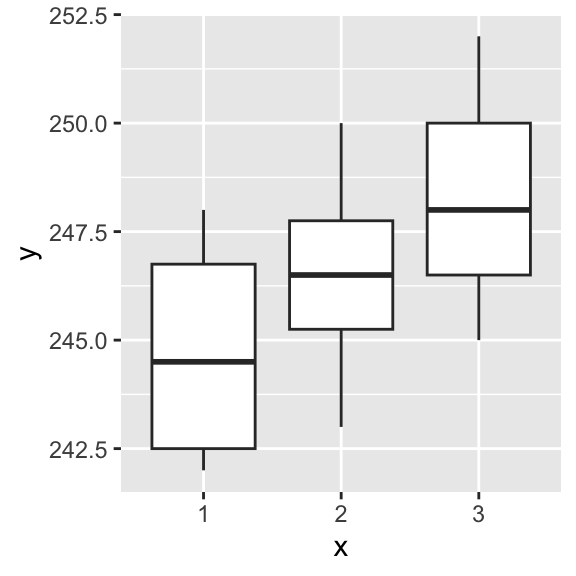
- Using
aov, \(Y\) is response, \(X\) is group.
##             Df Sum Sq Mean Sq F value  Pr(>F)
## x            2   61.4  30.700   6.181 0.00616 **
## Residuals   27  134.1   4.967
## ---
## Signif. codes:  0 '***' 0.001 '**' 0.01 '*' 0.05 '.' 0.1 ' ' 1
anova(fit.oneway.anova)## Analysis of Variance Table
##
## Response: y
## Df Sum Sq Mean Sq F value Pr(>F)
## x 2 61.4 30.7000 6.1812 0.006163 **
## Residuals 27 134.1 4.9667
## ---
## Signif. codes: 0 '***' 0.001 '**' 0.01 '*' 0.05 '.' 0.1 ' ' 1
model.tables(fit.oneway.anova, "means")## Tables of means
## Grand mean
##
## 246.5
##
## x
## x
## 1 2 3
## 244.8 246.4 248.3
# plot(fit.oneway.anova) #diagnostic plots
coefficients(fit.oneway.anova)
## (Intercept) x2 x3
## 244.8 1.6 3.5
TukeyHSD(fit.oneway.anova, "x", ordered = TRUE)## Tukey multiple comparisons of means
## 95% family-wise confidence level
## factor levels have been ordered
##
## Fit: aov(formula = y ~ x, data = coffee.data)
##
## $x
## diff lwr upr p adj
## 2-1 1.6 -0.8711391 4.071139 0.2606999
## 3-1 3.5 1.0288609 5.971139 0.0043753
## 3-2 1.9 -0.5711391 4.371139 0.1562593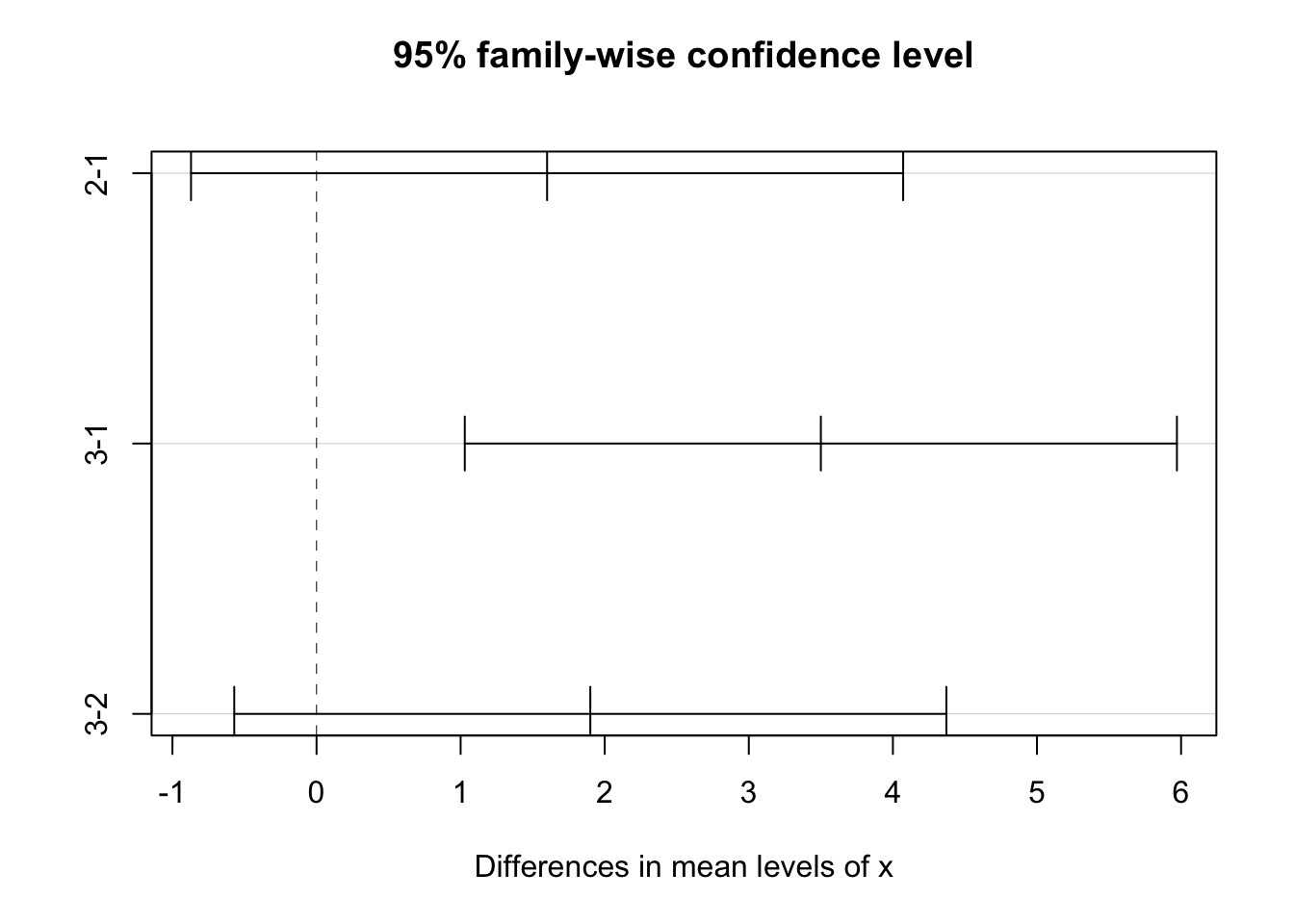
- Using
lm
##
## Call:
## lm(formula = y ~ x, data = coffee.data)
##
## Residuals:
## Min 1Q Median 3Q Max
## -3.400 -2.075 -0.300 1.675 3.700
##
## Coefficients:
## Estimate Std. Error t value Pr(>|t|)
## (Intercept) 244.8000 0.7047 347.359 < 2e-16 ***
## x2 1.6000 0.9967 1.605 0.12005
## x3 3.5000 0.9967 3.512 0.00158 **
## ---
## Signif. codes: 0 '***' 0.001 '**' 0.01 '*' 0.05 '.' 0.1 ' ' 1
##
## Residual standard error: 2.229 on 27 degrees of freedom
## Multiple R-squared: 0.3141, Adjusted R-squared: 0.2633
## F-statistic: 6.181 on 2 and 27 DF, p-value: 0.006163
anova(fit.coffee)## Analysis of Variance Table
##
## Response: y
## Df Sum Sq Mean Sq F value Pr(>F)
## x 2 61.4 30.7000 6.1812 0.006163 **
## Residuals 27 134.1 4.9667
## ---
## Signif. codes: 0 '***' 0.001 '**' 0.01 '*' 0.05 '.' 0.1 ' ' 1
model.matrix(fit.coffee)## (Intercept) x2 x3
## 1 1 0 0
## 2 1 0 0
## 3 1 0 0
## 4 1 0 0
## 5 1 0 0
## 6 1 0 0
## 7 1 0 0
## 8 1 0 0
## 9 1 0 0
## 10 1 0 0
## 11 1 1 0
## 12 1 1 0
## 13 1 1 0
## 14 1 1 0
## 15 1 1 0
## 16 1 1 0
## 17 1 1 0
## 18 1 1 0
## 19 1 1 0
## 20 1 1 0
## 21 1 0 1
## 22 1 0 1
## 23 1 0 1
## 24 1 0 1
## 25 1 0 1
## 26 1 0 1
## 27 1 0 1
## 28 1 0 1
## 29 1 0 1
## 30 1 0 1
## attr(,"assign")
## [1] 0 1 1
## attr(,"contrasts")
## attr(,"contrasts")$x
## [1] "contr.treatment"\(X_1\) is dropped. Compare ANOVA table with the 1-way ANOVA results.
- Using
lmwith the constrain on the sum of effects equals 0.
options(contrasts=c('contr.sum', 'contr.sum'))
fit.coffee <- lm(y~x, data = coffee.data)
summary(fit.coffee)
##
## Call:
## lm(formula = y ~ x, data = coffee.data)
##
## Residuals:
## Min 1Q Median 3Q Max
## -3.400 -2.075 -0.300 1.675 3.700
##
## Coefficients:
## Estimate Std. Error t value Pr(>|t|)
## (Intercept) 246.5000 0.4069 605.822 < 2e-16 ***
## x1 -1.7000 0.5754 -2.954 0.00642 **
## x2 -0.1000 0.5754 -0.174 0.86333
## ---
## Signif. codes: 0 '***' 0.001 '**' 0.01 '*' 0.05 '.' 0.1 ' ' 1
##
## Residual standard error: 2.229 on 27 degrees of freedom
## Multiple R-squared: 0.3141, Adjusted R-squared: 0.2633
## F-statistic: 6.181 on 2 and 27 DF, p-value: 0.006163
anova(fit.coffee)## Analysis of Variance Table
##
## Response: y
## Df Sum Sq Mean Sq F value Pr(>F)
## x 2 61.4 30.7000 6.1812 0.006163 **
## Residuals 27 134.1 4.9667
## ---
## Signif. codes: 0 '***' 0.001 '**' 0.01 '*' 0.05 '.' 0.1 ' ' 1
model.matrix(fit.coffee)## (Intercept) x1 x2
## 1 1 1 0
## 2 1 1 0
## 3 1 1 0
## 4 1 1 0
## 5 1 1 0
## 6 1 1 0
## 7 1 1 0
## 8 1 1 0
## 9 1 1 0
## 10 1 1 0
## 11 1 0 1
## 12 1 0 1
## 13 1 0 1
## 14 1 0 1
## 15 1 0 1
## 16 1 0 1
## 17 1 0 1
## 18 1 0 1
## 19 1 0 1
## 20 1 0 1
## 21 1 -1 -1
## 22 1 -1 -1
## 23 1 -1 -1
## 24 1 -1 -1
## 25 1 -1 -1
## 26 1 -1 -1
## 27 1 -1 -1
## 28 1 -1 -1
## 29 1 -1 -1
## 30 1 -1 -1
## attr(,"assign")
## [1] 0 1 1
## attr(,"contrasts")
## attr(,"contrasts")$x
## [1] "contr.sum"- Using
lm, without intercept (this is the means model):
##
## Call:
## lm(formula = y ~ x - 1, data = coffee.data)
##
## Residuals:
##    Min     1Q Median     3Q    Max
## -3.400 -2.075 -0.300  1.675  3.700
##
## Coefficients:
##    Estimate Std. Error t value Pr(>|t|)
## x1 244.8000     0.7047   347.4   <2e-16 ***
## x2 246.4000     0.7047   349.6   <2e-16 ***
## x3 248.3000     0.7047   352.3   <2e-16 ***
## ---
## Signif. codes:  0 '***' 0.001 '**' 0.01 '*' 0.05 '.' 0.1 ' ' 1
##
## Residual standard error: 2.229 on 27 degrees of freedom
## Multiple R-squared:  0.9999, Adjusted R-squared:  0.9999
## F-statistic: 1.223e+05 on 3 and 27 DF,  p-value: < 2.2e-16
anova(fit.coffee)## Analysis of Variance Table
##
## Response: y
## Df Sum Sq Mean Sq F value Pr(>F)
## x 3 1822929 607643 122344 < 2.2e-16 ***
## Residuals 27 134 5
## ---
## Signif. codes: 0 '***' 0.001 '**' 0.01 '*' 0.05 '.' 0.1 ' ' 1
model.matrix(fit.coffee)## x1 x2 x3
## 1 1 0 0
## 2 1 0 0
## 3 1 0 0
## 4 1 0 0
## 5 1 0 0
## 6 1 0 0
## 7 1 0 0
## 8 1 0 0
## 9 1 0 0
## 10 1 0 0
## 11 0 1 0
## 12 0 1 0
## 13 0 1 0
## 14 0 1 0
## 15 0 1 0
## 16 0 1 0
## 17 0 1 0
## 18 0 1 0
## 19 0 1 0
## 20 0 1 0
## 21 0 0 1
## 22 0 0 1
## 23 0 0 1
## 24 0 0 1
## 25 0 0 1
## 26 0 0 1
## 27 0 0 1
## 28 0 0 1
## 29 0 0 1
## 30 0 0 1
## attr(,"assign")
## [1] 1 1 1
## attr(,"contrasts")
## attr(,"contrasts")$x
## [1] "contr.treatment"1), 2) and 3) give the same ANOVA table. In 4), when the model does not include an intercept, the ANOVA table shows the uncorrected SS, i.e. \(\bar{y}\) not substracted:
| SOURCE | df | SS |
|---|---|---|
| Regression | p | SSR |
| Error | n-p | SSE |
| Total | n | SST |
Where \(SSR = \sum \hat{y}^2\), \(SSE = \sum(y - \hat{y})^{2}\) and \(SST = \sum y^{2}\).
It is also possible to fit the model by explicitly specifying the dummy variables.
# or using dummy variables

d1 <- as.numeric(coffee.data$x == 1)
d2 <- as.numeric(coffee.data$x == 2)
d3 <- as.numeric(coffee.data$x == 3)

fit.coffee.dummy <- lm(coffee.data$y ~ d1 +d2)
summary(fit.coffee.dummy)
##
## Call:
## lm(formula = coffee.data$y ~ d1 + d2)
##
## Residuals:
## Min 1Q Median 3Q Max
## -3.400 -2.075 -0.300 1.675 3.700
##
## Coefficients:
## Estimate Std. Error t value Pr(>|t|)
## (Intercept) 248.3000 0.7047 352.326 < 2e-16 ***
## d1 -3.5000 0.9967 -3.512 0.00158 **
## d2 -1.9000 0.9967 -1.906 0.06730 .
## ---
## Signif. codes: 0 '***' 0.001 '**' 0.01 '*' 0.05 '.' 0.1 ' ' 1
##
## Residual standard error: 2.229 on 27 degrees of freedom
## Multiple R-squared: 0.3141, Adjusted R-squared: 0.2633
## F-statistic: 6.181 on 2 and 27 DF, p-value: 0.006163##
## Call:
## lm(formula = coffee.data$y ~ d1 + d2 + d3 - 1)
##
## Residuals:
## Min 1Q Median 3Q Max
## -3.400 -2.075 -0.300 1.675 3.700
##
## Coefficients:
## Estimate Std. Error t value Pr(>|t|)
## d1 244.8000 0.7047 347.4 <2e-16 ***
## d2 246.4000 0.7047 349.6 <2e-16 ***
## d3 248.3000 0.7047 352.3 <2e-16 ***
## ---
## Signif. codes: 0 '***' 0.001 '**' 0.01 '*' 0.05 '.' 0.1 ' ' 1
##
## Residual standard error: 2.229 on 27 degrees of freedom
## Multiple R-squared: 0.9999, Adjusted R-squared: 0.9999
## F-statistic: 1.223e+05 on 3 and 27 DF, p-value: < 2.2e-164.10 Confidence intervals and hypothesis tests for linear combinations of \(\boldsymbol{\beta}\)
From the theory of OLS:
\[\hat{\boldsymbol{\beta}} \sim N(\boldsymbol{\beta},(\mathbf{X}^T\mathbf{X})^{-1}\sigma^2)\]
and
\[\mathbf{c}^T\hat{\boldsymbol{\beta}} \sim N(\mathbf{c}^T\boldsymbol{\beta},\mathbf{c}^T(\mathbf{X}^T\mathbf{X})^{-1}\mathbf{c}\sigma^2)\]
For the caffeine example (1 way ANOVA model): suppose we want to compare the treatment means with the control mean, that is, we want a CI for:
\[\frac{\mu_2+\mu_3}{2}-\mu_1\]
Let \(\mathbf{c}^T= (-1, 1/2, 1/2)\), \(\boldsymbol{\beta}^T = (\mu_1, \mu_2, \mu_3)\).
\[\mathbf{c}^T\boldsymbol{\beta} = -\mu_1+\mu_2/2+ \mu_3/2\]
is estimated by:
\[\mathbf{c}^T\hat{\boldsymbol{\beta}} = -\bar{y}_{1.}+\bar{y}_{2.}/2+ \bar{y}_{3.}/2\]
and the variance is:
\[\begin{bmatrix} -1 & 1/2 & 1/2 \end{bmatrix} \frac{1}{10}\mathbf{I}_3 \begin{bmatrix} -1 \\ 1/2 \\ 1/2\end{bmatrix}\sigma^2 = \frac{3}{20}\sigma^2\]
So, the \(100 \times (1- \alpha) \%\)CI is:
\[\mathbf{c}^T\hat{\boldsymbol{\beta}} \pm t_{27}(\alpha/2) \sqrt{\frac{3}{20}\hat{\sigma}^2}\]
The df is: \(n-g = 30-3 = 27\).
We could also test hypotheses e.g. \(H_o: \mathbf{c}^T\boldsymbol{\beta} = 0\). The test statistic:
\[\frac{\mathbf{c}^T\hat{\boldsymbol{\beta}}}{\sqrt{\frac{3}{20}\hat{\sigma}^2}} \sim t_{27}.\]